 Veterinary Training Course in Dhaka Pharmacy, Dental, Nursing, Veterinary, Physiotherapy, Pathology and Homeopathy training course



Veterinary Pharmacy Course 1 Year Details
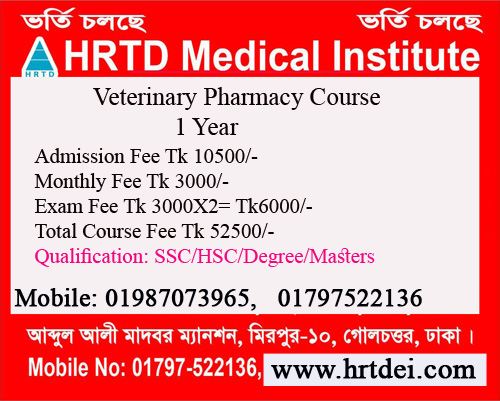
Veterinary Pharmacy Course 1 Year. Mobile Phone Number 01797522136, 01987073965. Veterinary Pharmacy Course 1 Year Contains 10 Subjects. Total Course Fee Tk 52500/- including admission fee tk 10500, Monthly fee tk 3000/-, and exam fee tk 3000/-+ Tk 3000/-.
The subjects are Veterinary Anatomy and Physiology, Veterinary Pharmacology, Veterinary Antimicrobial Drugs, First Aid Veterinary OTC Drugs, and Veterinary Vaccination. Veterinary Microbiology, Animal Infectious Disease, Zoonotic Disease, Biosecurity, Animal Farm Management, Veterinary Hematology, Veterinary Pathology, Practice of Veterinary Medicine, etc. Veterinary Pharmacy Course 1 Year is available at HRTD Medical Institute.
Location of Veterinary Pharmacy Course 1 Year
HRTD Medical Institute, Abdul Ali Madbor Mansion, Section-6, Block-Kha, Road-1, Plot-11, Mirpur-10 Golchattar, Metro Rail Piller No. 249, Dhaka-1216. Mobile Phone Number: 01797522136, 01987073965.
Teachers for Veterinary Pharmacy Course 1 Year
Dr. Tariqul Gani, DVM, MS
Dr. Apel Mahmud, DVM, MS
Dr. Sharmin Sultana, DVM, MS
Dr. Arefin Habib, DVM, MS
Dr. Mosharof Hossain, DVM, MS, Ph D
Dr. Moniruzzaman, DVM
Dr. Repon, DVM, MS
Dr. Kazi Fatema, DVM, MS
Eti Zahan, BSc Nurse
Course Fee for Veterinary Pharmacy Course 1 Year
Admission Fee Tk 10500/-
Monthly Fee Tk 3000/-
Exam Fee Tk 3000/- + Tk 3000/- = Tk 6000/-
Total Course Fee Tk 52500/-
Practical Class and Internship for Veterinary Pharmacy Course 1 Year
Heart Beat, Heart Rate, Pulse, Pulse Rate, Strong Pulse, Weak Pulse, Tachycardia, Bradycardia, Blood Pressure, Normal Blood Pressure, Systolic Blood Pressure, Diastolic Blood Pressure, Pulse Pressure, Mean Blood Pressure, Hypertension, Hypotension, Anemia, Cleaning, Dressing, Bandaging, Stitching, Blood Glucose, Edema, Dehydration, Nebulizer, Oxygen Inhalation, Pulse Oxymeter, Shock Management, Pressure Management, etc
হৃদস্পন্দন, হৃদস্পন্দন, নাড়ি, নাড়ির হার, তীব্র নাড়ি, দুর্বল নাড়ি, টাকাইকার্ডিয়া, ব্র্যাডিকার্ডিয়া, রক্তচাপ, স্বাভাবিক রক্তচাপ, সিস্টোলিক রক্তচাপ, ডায়াস্টোলিক রক্তচাপ, নাড়ির চাপ, গড় রক্তচাপ, উচ্চ রক্তচাপ, হাইপোটেনশন, রক্তাল্পতা, পরিষ্কার করা, ড্রেসিং, ব্যান্ডেজিং, সেলাই, রক্তের গ্লুকোজ, শোথ, পানিশূন্যতা, নেবুলাইজার, অক্সিজেন ইনহেলেশন, নাড়ি অক্সিমিটার, শ্বসন পরীক্ষা শক ম্যানেজমেন্ট, প্রেসার ম্যানেজমেন্ট, ইত্যাদি।
Anatomy and Physiology for Veterinary Pharmacy Course 1 Year
Veterinary Anatomy and Physiology are important subjects for the Veterinary Pharmacy Course. The study of body structure and its functions is called anatomy and physiology. Here we discuss the systems of the Human Body and its Organs, Tissues, and Cells. The systems of the Human Body are the Nervous System, Digestive System, Respiratory System, Circulatory System or Cardiovascular System, Skeletal System, Muscular System, Endocrine System, Immune System, Lymphatic System, Integumentary System or Covering System, and Urinary System.
Veterinary Pharmacology for Veterinary Pharmacy Course 1 Year
The study of Veterinary Drugs and Medicines is called Veterinary Pharmacology. Drugs are chemicals that can react with cells, tissues, and body organs. Here we discuss group-wise drugs and their medicines. Common Groups of Drugs are Pain Killer Drugs, Anti Ulcer Drugs, Anti Vomiting Drugs, Anti Viral Drugs, Laxative Drugs, Motility Drugs and Antimotility Drugs, Bronchodilator Drugs, Antibiotic Drugs, Anti Fungal Drugs, Anti Thrombotic Drugs, Anti Protozoal Drugs, Anthelmintic Drugs, Anti Hypertensive Drugs, Beta Blocker Drugs, Calcium Channel Blocker Drugs, ACE Inhibitor Drugs, Hemostatic Drugs, Analgesic Drugs, Antipyretic Drugs, Steroid Drugs, NSAID Drugs, CNS Drugs, Neuropathic Pain Keller Drugs, Spasmodic Drugs, etc.
First Aid for Veterinary Pharmacy Course 1 Year
First Aid is an important subject for all courses. It is important for the Veterinary Pharmacy Course. Here we discuss Shock, Classifications of Shock, Causes of Shock, Stages of Shock, Clinical Features of Shock, Hypovolemic Shock, Cardiogenic Shock, Neurogenic Shock, Traumatic Shock, Burn Shock, Electric Shock, Psychogenic Shock, Anaphylactic Shock, First Aid of Shock, Management of Shock, First Aid of Cut, First of Snake Bite, First Aid of Accidental Injury, etc.
Veterinary OTC Drugs for Veterinary Pharmacy Course 1 Year
Veterinary OTC is the short form of over-the-counter. That is OTC Drugs are over-the-counter drugs. The study of OTC Drugs is important for Veterinary Pharmacy Courses. These Drugs can be sold or purchased without a prescription from Registered Veterinary DVM Doctors. These Drugs are Emergency and Safe for the patients. The study of OTC Drugs improves the quality of practice. Some OTC Drugs are Paracetamol, Albendazole, Ascorbic Acid, Calcium, Multivitamins, Vitamin B Complex, Omeprazole, Oral Rehydration Salt, Salbutamol, Mebendazole, Neomycin, Gentamycin, Bacitracin, etc.
Antimicrobial Drugs for Veterinary Pharmacy Course
The Drugs that are used for the treatment of Infectious Diseases are Antimicrobial Drugs. Microorganisms are Bacteria, Protozoa, Fungus, and Virus. Antimicrobial Drugs are Antibiotic Drugs ( Antibacterial Drugs), Anti-Protozoal Drugs, Anti Fungal Drugs, and Anti Viral Drugs. Antibacterial groups are the Macrolide Group, Cephalosporin Group, Fluroquinolone Group, Penicillin Group, Tetracycline Group, Aminoglycosides Group, and Lincosamine Group. Common Drugs of Macrolide Groups are Azithromycin, Roxithromycin, Erythromycin, and Clarithromycin. Drugs of the Fluoroquinolone group are Nalidixic Acid, Ciprofloxacin, Lomefloxacin, Levofloxacin, Ofloxacin, Gemifloxacin, Gatifloxacin, etc. Common Drugs of the Cephalosporin Group are Cefalexin, Cephradine, Cefaclor, Cefuroxime, Cefixime, Ceftriaxone, etc. Common Aninoglycodie Drugs are Neomycin, Gentamycin, Becitracin, Tobramycin, etc.
Hematology and Pathology for Veterinary Course 1 Year
Hematology and Pathology are important subjects in Veterinary science. The Blood and Blood Disease study is called Hematology and the Study of Pathos is called Pathology. In Hematology and Pathology, we discuss blood cells, their morphology and functions, Blood Diseases, Common Pathos and their pathogenesis, Atrophy, Hypertrophy, Metaplasia, Gangrene, Pathological Tests like TC, DC, ESR, Hemoglobin Percentage, etc. Common Blood diseases are Anemia and Thalasemia. Common Anemias are Iron Deficiency Anemia and megaloblastic Anemia.
Practice of Veterinary Medicine for Pharmacy Course 1 Year
The study of Disease and Treatment is called the Practice of Medicine. Actually, the Practice of Medicine means the use of medicine for treatments. This subject is important for the veterinary pharmacy course for 1 year. This subject discusses some common diseases. The points of discussion for the Practice of Medicine are the Definition of Disease, Causes of Disease, Clinical Features of Disease ( Symptoms and Signs), Investigation of Disease, Treatment of Disease, Complication of Disease, and Advice for the Patients.
Index / Table of Contents
1️⃣ Introduction to Veterinary Medicine
2️⃣ Difference Between Human and Veterinary Medicine
3️⃣ Common Systems and Their Diseases
4️⃣ Diagnosis and Clinical Examination
5️⃣ Prescription Writing and Dose Calculation
6️⃣ Common Veterinary Drugs and Their Uses
7️⃣ Routes of Drug Administration in Animals
8️⃣ Infectious and Non-Infectious Diseases
9️⃣ Emergency Management in Veterinary Practice
🔟 Preventive Veterinary Medicine (Vaccination & Deworming)
1️⃣1️⃣ Veterinary Pharmacy Practice in Field & Hospital
1️⃣2️⃣ Laboratory Safety, Ethics, and Record Keeping
🧠 Introduction to Veterinary Medicine
Definition:
Veterinary Medicine is the branch of medical science that deals with the prevention, diagnosis, and treatment of diseases, disorders, and injuries in animals.
Objectives:
- To maintain animal health and productivity
- To prevent zoonotic diseases (transmitted to humans)
- To ensure safe animal products (milk, meat, egg)
⚖️ Difference Between Human & Veterinary Medicine
| Basis | Human Medicine | Veterinary Medicine |
|---|---|---|
| Patient | Human | Animals (cattle, goat, dog, cat, etc.) |
| Dose Calculation | Standard adult dose | Depends on species & body weight |
| Prescription | For one species | For multiple species |
| Drugs | Human formulation | Veterinary formulation (bolus, premix, etc.) |
| Regulations | Human Drug Act | Veterinary Drug Act |
🩺 Common Systems and Their Diseases
| System | Common Diseases | Example of Drugs Used |
|---|---|---|
| Digestive | Diarrhea, Indigestion | Metronidazole, ORS |
| Respiratory | Pneumonia, Cough | Oxytetracycline, Dexamethasone |
| Reproductive | Metritis, Retention of placenta | Oxytocin, PGF2α |
| Urinary | Cystitis | Sulfadimidine |
| Musculoskeletal | Lameness, Arthritis | Analgesics, Anti-inflammatory |
| Skin | Mange, Ringworm | Ivermectin, Antifungal ointment |
🧫 Diagnosis and Clinical Examination
Steps in Animal Diagnosis:
- History taking
- Physical examination (Temperature, Pulse, Respiration)
- Observation of clinical signs
- Laboratory tests (Blood, Urine, Feces)
- Differential diagnosis
- Treatment plan
💊 Prescription Writing and Dose Calculation
Parts of a Prescription:
- Superscription (Rx)
- Inscription (Name of drugs)
- Subscription (Directions to compound)
- Signature (Instructions for use)
- Name, date, and signature of prescriber
Example:
Rx: Oxytetracycline Inj. 10 mg/kg IM daily × 5 days
Antipyretic bolus 1 tab BID × 3 days
Dose Formula: Required Dose=Body Weight (kg)×Recommended Dose (mg/kg)\text{Required Dose} = \text{Body Weight (kg)} \times \text{Recommended Dose (mg/kg)}Required Dose=Body Weight (kg)×Recommended Dose (mg/kg)
🧴 Common Veterinary Drugs and Their Uses
| Drug Name | Class | Uses | Withdrawal Period |
|---|---|---|---|
| Oxytetracycline | Antibiotic | Bacterial infections | 7 days |
| Albendazole | Anthelmintic | Deworming | 3 days |
| Ivermectin | Antiparasitic | External & internal parasite | 14 days |
| Dexamethasone | Steroid | Anti-inflammatory | 3 days |
| Paracetamol | Antipyretic | Fever control | 0 day |
💉 Routes of Drug Administration
| Route | Example | Remarks |
|---|---|---|
| Oral | Bolus, Syrup | Easy & common |
| Intramuscular (IM) | Oxytetracycline inj. | Moderate absorption |
| Intravenous (IV) | Fluid, Antibiotics | Rapid effect |
| Subcutaneous (SC) | Vaccines | Slow absorption |
| Topical | Ointment, Cream | Local effect |
🦠 Infectious & Non-Infectious Diseases
| Type | Example | Cause |
|---|---|---|
| Infectious | FMD, Rabies, Anthrax | Bacteria / Virus |
| Non-Infectious | Ketosis, Milk fever | Nutritional / Metabolic |
| Parasitic | Worm infestation, Mange | Parasite |
| Zoonotic | Rabies, Brucellosis | Transmissible to humans |
🚑 Emergency Management
Common Emergencies:
- Poisoning → Wash stomach, give antidote
- Shock → IV fluid, corticosteroid
- High fever → Antipyretic, antibiotic
- Bloat → Stomach tube, antifoaming agent
- Hemorrhage → Adrenaline, dressing
💉 Preventive Veterinary Medicine
Vaccination Schedule (Example):
| Animal | Vaccine | Age/Interval |
|---|---|---|
| Cow | FMD, HS, BQ | 6 months interval |
| Goat | PPR, Enterotoxemia | Yearly |
| Dog | Anti-rabies | Yearly |
Deworming: Every 3–4 months using Albendazole or Fenbendazole.
🏥 Veterinary Pharmacy Practice
- Maintain drug register and expiry records
- Keep controlled drugs under lock and key
- Maintain cold chain for vaccines
- Educate farmers about drug use and withdrawal period
🧼 Laboratory Safety & Record Keeping
- Use lab coat, gloves, and disinfectants
- Avoid contamination of samples
- Record every case with date, animal details, and treatment given
Practical for Veterinary Pharmacy Course 1 Year
Auscultation, Heart Beat, Heart Rate, Heart Sound, Pulse, Blood Pressure, Respiratory Rate, Nebulizer, Blood Oxygen, Cyanosis, Blood Glucose (Diabetes), Body Temperature, Dehydration Test, Edema Test, IM Injection, IV Injection, Saline Infusion, Cleaning, Dressing, Bandaging, and Stithcinbg.
Some Short Veterinary Courses
Paramedical Vet 1 Year, Paramedical Vet 2 Years, Paramedical Vet 3 Years, Diploma Medical Assistant in Veterinary. DMA Vet 1 Year, Diploma Medical Assistant in Veterinary DMA Vet 2 Years, Diploma Medical Assistant in Veterinary DMA Vet 3 Years, Diploma in Medicine and Surgery DMS Vet 1 Year, Diploma in Medicine and Surgery DMS Vet 2 Years, DMS Vet 3 Years, LMA Vet 6 Months, LMA Vet 1 Year, RMP Vet 6 Months, RMP Vet 1 Year, DPM Vet 2 Years, DPM Vet 3 Years, DMDS Vet 4 Years, DMSc Vet 4 Years. All the Veterinary Courses are available at HRTD Medical Institute.
Practical for Veterinary Pharmacy Course 1Year:
🔹 1. Objectives of Veterinary Pharmacy Practical
- বিভিন্ন পশু ঔষধ ও ডোজ ফর্ম চেনা ও ব্যবহার শেখা
- প্রেসক্রিপশন লেখা ও গণনা শেখা
- ঔষধ সংরক্ষণ, লেবেলিং ও নিরাপত্তা সম্পর্কে ধারণা অর্জন
- ইনজেকশন, মিক্সচার, পাউডার, অয়েন্টমেন্ট ইত্যাদি প্রস্তুত করা
- পশুচিকিৎসায় ব্যবহৃত অ্যান্টিবায়োটিক, অ্যান্টিপ্যারাসাইটিক, ওষুধ ব্যবস্থাপনা অনুশীলন
🔹 2. List of Practicals
| Serial | Name of Practical | Learning Outcome | Remarks |
|---|---|---|---|
| 1 | Identification of veterinary drugs | Know common veterinary drugs | ✅ |
| 2 | Prescription writing practice | Write complete veterinary prescriptions | ✅ |
| 3 | Calculation of doses for animals | Correct dosage by body weight | ✅ |
| 4 | Preparation of oral mixture/suspension | Practical formulation skill | ✅ |
| 5 | Preparation of ointment and cream | Learn topical formulations | ✅ |
| 6 | Sterilization & aseptic technique | Maintain sterile environment | ✅ |
| 7 | Labeling and storage of drugs | Learn safe storage & labeling | ✅ |
| 8 | Demonstration of injections (IM, IV, SC) | Learn route of drug administration | ✅ |
| 9 | Handling of vaccines & cold chain maintenance | Understand vaccine management | ✅ |
| 10 | Preparation of electrolyte solution | Learn fluid therapy basics | ✅ |
🔹 3. Prescription Writing Practice (Example)
Patient: Cow
Weight: 350 kg
Diagnosis: Mastitis
Rx:
- Inj. Oxytetracycline 10 mg/kg IM daily × 3 days
- Mastitis tube (Local) × 3 days
- Antipyretic: Paracetamol bolus 1 tab × BID × 3 days
Signature: ___________________
🔹 4. Label Format Example
| Field | Description |
|---|---|
| Name of Drug | Oxytetracycline Injection |
| Strength | 100 mg/ml |
| Batch No | 024/25 |
| Mfg. Date | 10/2025 |
| Exp. Date | 10/2027 |
| Storage | Keep in cool, dry place |
| For | Veterinary use only |
🔹 5. Safety Rules in Veterinary Pharmacy Lab
- ল্যাবে ঢোকার আগে ল্যাব কোট ও গ্লাভস পরতে হবে
- ওষুধের গন্ধ বা স্বাদ নিজে যাচাই করা নিষিদ্ধ
- সূচ বা ইনজেকশন ব্যবহারের পরে সেফ ডিসপোজাল করতে হবে
- রাসায়নিক ছিটকে পড়লে তৎক্ষণাৎ শিক্ষককে জানাতে হবে
🔹 6. Viva Questions (Common)
- Veterinary pharmacy কী?
- Dose ও Dosage form এর মধ্যে পার্থক্য কী?
- Withdrawal period মানে কী?
- Veterinary drug labeling এ কী কী তথ্য থাকতে হবে?
- Injectable drugs কিভাবে সংরক্ষণ করা হয়?